


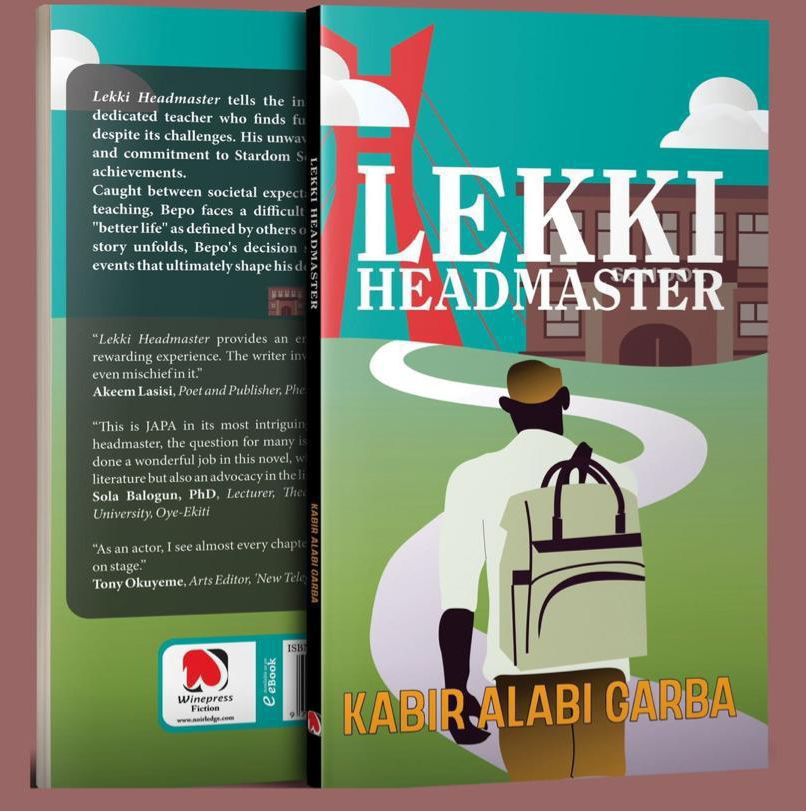
Lekki Headmaster JAMB Novel: Comprehensive summary of “The Lekki Headmaster” by Kabir Alabi Garba – the official 2026/2027 JAMB novel. Explore the story of Mr. Bepo, a dedicated principal torn between joining his family in the UK and his passion for Nigerian education. Includes detailed plot, characters, themes, and study notes for JAMB UTME success.
ABOUT THE AUTHOR [Lekki Headmaster JAMB Novel]
Kabir Alabi Garba is a seasoned journalist, author, and advocate for quality education in Nigeria with years of experience in the media industry. He holds a Ph.D. from the Department of Mass Communication at the University of Lagos. His literary works frequently examine leadership, migration, education, and cultural heritage, reflecting societal issues facing contemporary Nigerians.
SETTING
The novel is predominantly set in Lekki, Lagos, Nigeria, specifically at Stardom Schools, and takes place in 2022, two years after the COVID-19 pandemic. The story unfolds against the backdrop of Nigeria’s “Japa syndrome”—the mass exodus of professionals seeking better opportunities abroad.
References are made to various locations across Lagos and Nigeria, including excursions that showcase the country’s physical and cultural beauty despite its socio-political challenges.
DETAILED PLOT SUMMARY
Opening Crisis: Chapter 1 – Dusk
The novel opens dramatically during a morning assembly at Stardom Schools when the principal, Mr. Bepo Adewale, walks to the podium looking distressed and disoriented, his trademark smile absent. Known for his charismatic and energetic personality, Bepo’s unusual behavior shocks students and staff alike. He stares blankly above the students’ heads, attempts to speak but fails, and then breaks down crying uncontrollably in front of the entire school.
The Vice Principal, Mrs. Grace Apeh, quickly intervenes, instructing the Chemistry teacher, Mr. Justus Anabel, to conclude the assembly and dismiss students to their classes. Staff members escort the sobbing principal to his office, where he continues weeping for over thirty minutes, unable to explain his distress. He occasionally mutters phrases like “Oluwa gba mi o!” (God, save me!).
This incident is particularly shocking because it occurred just one day after the school celebrated an impressive 90% success rate in the West African School Certificate Examination (WASSCE). The school had also recently reduced boarding fees from ₦250,000 to ₦165,000 per session, encouraging 80% of parents to enroll their children in the boarding house.
As news of the principal’s breakdown spreads among parents, the Vice Principal contacts the Managing Director, Mrs. Ibidun Gloss, who is attending a function outside the school. The MD returns promptly, deeply concerned about both Bepo’s well-being and the potential impact on the school’s reputation.
The MD involves Mr. Ope Wande, the school’s Physics teacher and a pastor, to counsel the principal. After unsuccessful attempts to get Bepo to open up, Pastor Wande suggests contacting Bepo’s wife, Seri, who lives in London. The MD tries calling her, but there’s no answer.
Despite efforts to console him, Bepo remains deeply upset, and the MD decides to send him home under the supervision of the guidance counselor, Mrs. Beke Egbin.
The Dilemma Revealed: Chapter 2
After days of silence and emotional distress, Mr. Bepo finally reveals his dilemma—he is relocating to the United Kingdom to join his family, a decision that is far from easy for him. His wife, Seri, a nurse who has already moved to the UK with their two children, Nike and Kike, has been pressuring him to leave Nigeria. The family’s absence has strained their marriage, leaving Bepo feeling he has no choice but to resign from his beloved position.
Bepo recalls his two decades of service at Stardom Schools, where he gained the nickname “The Lekki Headmaster” due to his charisma and problem-solving skills, particularly his ability to resolve conflicts, including petty staff disputes. He had served as Headmaster at Stardom Kiddies for four years before being transferred to the secondary section, where he worked for 20 years. His nickname came from his humorous imitations of characters from the old TV drama “The Village Headmaster.”
His colleagues struggle to understand his hesitation, viewing his UK job offer as a golden opportunity, with his wife rumored to earn £10,000 monthly as a nurse while he would make £3,600—far more than his Nigerian salary of ₦400,000. Mr. Audu, the Fine Arts teacher, jokingly claims he would head straight to the airport to replace Bepo as Seri’s husband.
Beyond financial considerations, Bepo had personal aspirations that complicated his decision. He had envisioned retiring at 55 and venturing into entrepreneurship—possibly starting his own school to mold young minds and provide employment, or exploring other ventures like farming or commercial transportation. However, practical challenges, including a lack of capital and past business failures, tempered these ambitions.
Past Experiences and Dark Memories
The novel delves into Bepo’s early days in the education sector. He had attempted to establish a school called “Fruitful Future” with a colleague, employing innovative teaching methods. Despite their noble intentions, the school failed due to infrastructural challenges and a lack of government support, underscoring the struggles educators face in a system plagued by corruption and neglect.
The chapter concludes with a shocking twist when a news report implicates a familiar figure, Mr. Ogo, in a ritual murder, tying back to a mysterious burial at Beesway and deepening Bepo’s disillusionment with the dark realities around him. During his career, Bepo had witnessed the dark underbelly of private school education in Nigeria, ranging from corruption to disturbing allegations of ritualism, experiences that forged his character and commitment to integrity.
School Life and Administrative Challenges
Throughout the novel, various subplots illustrate the complexities of running a private school in Nigeria. The school management deals with:
- Grammar controversies: A teacher named Fafore faces dismissal over a grammatical blunder, creating tension that is later eased when Bepo intervenes and Audu provides comic relief with his humor. The Ministry of Education’s failure to notice a grammatical error in a school’s name (“Beesway Group of School” instead of “Schools”) highlights systemic inefficiency.
- Parental disputes: The school handles a legal dispute between two families of students, with one parent suing the school after their daughter was asked to write on the marker board for others to copy, claiming “visual exploitation.” The matter was settled out of court, with the student receiving one tuition-free term and the teacher being suspended without pay for three months.
- Dedicated staff: Despite living in distant areas like Ifo, Ojo, and Ofada, some teachers, like Fafore, wake up as early as 4:00 AM to arrive at school by 6:00 AM. Fafore had won the “most punctual teacher” award twice.
- Student achievements: A student named Ikenna Egbu (an SSS 1 Science student who also acts as a poet) delivers a captivating speech about the school’s recent excursion to Jos, describing the “acrobatic beauty” of Jos rocks and the Shere Hills, creating excitement during assembly.
Excursions and Cultural Experiences
The novel features several school excursions that emphasize the importance of education, cultural identity, and leadership:
- Badagry excursion: Stardom Schools had previously organized trips to Badagry, where students visited renowned historical sites while teachers enjoyed a retreat at the Whispering Palms Resort.
- Jos excursion: JSS 1 students visited Jos, experiencing the Lamingo Dam and the unique weather and rock formations of the area.
These excursions showcase Nigeria’s physical, psychological, and cultural beauty despite corruption and inefficiency in public institutions.
The Farewell Preparations
As Bepo prepares to leave, the school community organizes various farewell activities:
- A novelty match refereed by Mr. Ibe, the Games Master
- Prefect elections are conducted through a democratic process
- A grand farewell party was organized by management, students, and staff
During the farewell period, tributes pour in from students, staff, and parents who recognize Bepo’s 24 years of dedicated service. He is described as “an inspiring pillar at Stardom for 24 years,” regarded by parents, employers, and stakeholders as a “school builder” who is passionate about students’ growth.
Even his landlord—a rarity in Lagos—is at peace with him, despite the notorious hostility of Lagos landlords (whom one character, Fafore, describes as “land gods”).
The farewell package includes a generous take-home gift of over $10,000 from the school, and colleagues provide a red-carpet escort to the airport.
The Climactic Decision: Chapter 12
The climax occurs when Bepo’s decision to leave Nigeria creates an emotional void, leading him to reflect deeply on his purpose; in a surprising turn, Bepo returns to Stardom Schools, declaring his heart and mission remain there.
On the Monday following Bepo’s supposed departure, the void left by his absence was palpable at Stardom Schools, with students and staff feeling the loss deeply, especially during morning assembly, a routine Bepo had made memorable with his warm presence.
However, just as the community begins to confront this reality, an unexpected twist unfolds. To everyone’s surprise and joy, Bepo returns to the school. As students dance around him singing the school’s victory song, Bepo declares, “I am here to complete my mission!” realizing that his legacy at Stardom would never fade.
The novel ends on an inspiring note as the school community joyously welcomes Bepo back, reaffirming their loyalty and appreciation for his leadership; his decision to stay symbolizes his commitment to shaping future generations and preserving cultural and educational values.
MAJOR CHARACTERS
Mr. Bepo Adewale (Adebepo Adewale): The protagonist and principal of Stardom Schools. A tall, always smart, light-skinned, ever-smiling University of Benin graduate known for his passion, carriage, and mastery of words.
He initiated the morning “pep talk” seven years earlier and is characterized by his compassionate leadership, commitment to cultural preservation, integrity, and belief in education’s transformative power. His soft and vulnerable side is revealed when he cries openly during the assembly.
Mrs. Seri Adewale: Bepo’s wife, a nurse living in the UK with their children. She represents the economic pressures and “Japa syndrome” affecting Nigerian families, pressuring Bepo to relocate.
Nike and Kike: Bepo’s two children are living with their mother in the UK.
Mrs. Ibidun Gloss: The Managing Director of Stardom Schools. She represents school management in the highbrow Lekki environment and is deeply concerned about the school’s reputation and success.
Mrs. Grace Apeh: The Vice Principal who steps in during Bepo’s breakdown and helps manage the crisis.
Mr. Jeremi Amos: The school’s accountant.
Mr. Ope Wande: Physics teacher and pastor who counsels Bepo during his crisis.
Mrs. Beke Egbin: The guidance counselor assigned to supervise Bepo.
Mr. Audu: Fine Arts teacher known for his humor and comic relief. He calls the MD “a witch and wizard rolled into one” and jokes about replacing Bepo as Seri’s husband.
Mr. Justus Anabel: Chemistry teacher who concludes the assembly during Bepo’s breakdown.
Fafore: A dedicated teacher who commutes long distances and wins punctuality awards but faces dismissal over a grammatical error.
Ikenna Egbu: An SSS 1 Science student and poet who delivers captivating speeches about school excursions.
Mr. Ibe: Games Master and referee for school sports events.
Mrs. Titi: The school nurse.
Mr. Oyelana: CRK (Christian Religious Knowledge) teacher.
Mr. Ogo: A figure implicated in ritual murder, representing the dark corruption in society.
Mr. Guta: Parent of two students at Stardom Schools.
Mr. Egi Meko: Director at Beesway Group of Schools.
MAJOR THEMES
1. The Japa Syndrome (Brain Drain vs. Patriotism)
This is arguably the most dominant theme in the novel, exploring the mass exodus of Nigerian professionals to foreign countries through the conflict between Bepo and his wife, Seri.
The novel asks difficult questions: Is relocating to the UK an act of seeking a better life, or is it abandoning one’s country when it needs fixing? Bepo’s hesitation represents the patriots’ struggle, while Seri represents the economic reality facing many Nigerian families.
2. Education and Leadership
The novel explores the transformative power of education and the role of school administrators in shaping students’ lives. Bepo is portrayed as a dedicated and principled leader who upholds discipline, fairness, and moral values. His leadership style emphasizes empathy, conflict resolution, and passion for student growth in all ramifications.
3. Corruption in the Education System
Issues like exam malpractice, favoritism, misuse of school resources, ritualism, and governmental neglect are highlighted, showing how corruption affects educational institutions and broader society.
4. Sacrifice and Purpose
The novel is a poignant narrative about sacrifice, purpose, and the transformative power of education, with Bepo’s journey serving as a testament to resilience, the value of education, and the courage it takes to stay true to one’s calling.
5. Family Loyalty vs. Professional Dedication
The tension between Bepo’s family obligations and his professional commitment creates the central conflict, exploring how individuals navigate personal fulfillment against societal definitions of success.
6. Social Class and Political Influence
The novel examines how wealthy and politically connected individuals influence school policies, teacher employment, and student discipline in Nigeria’s private education sector.
7. Cultural Preservation
Through excursions and educational programs, the novel emphasizes the importance of preserving Nigerian cultural heritage and identity even as many seek opportunities abroad.
8. Resilience and Hope
Despite systemic challenges, corruption, and personal struggles, the novel ultimately conveys a message of hope, renewal, and the possibility of positive change through dedication and integrity.
LITERARY SIGNIFICANCE
The novel is told from the omniscient point of view but with a limited omniscient narrator, presenting material from Bepo’s third-person perspective. The author occasionally intrudes through characters or flashbacks to provide a broader context.
The narrative uses mood and atmosphere effectively, switching from excitement to fear and anxiety, then from sadness to joy, particularly during key moments like the assembly breakdown and Bepo’s return.
The novel employs irony effectively—for instance, the Ministry of Education failing to notice grammatical errors in registered school names, and the most punctual teacher facing dismissal over a grammatical mistake.
CONCLUSION
“The Lekki Headmaster” is more than just a JAMB novel—it’s a profound reflection on contemporary Nigerian society, capturing the tensions between economic survival and patriotic duty, personal ambition and professional dedication, tradition and modernity.
Through Bepo’s journey, Kabir Alabi Garba creates a compelling narrative that resonates with anyone who has faced the difficult choice between comfort and calling, between leaving and staying, between what is easy and what is right.
The novel’s ending provides hope and inspiration, suggesting that true fulfillment comes not from external rewards but from staying true to one’s mission and values. Bepo’s return to Stardom Schools symbolizes the power of purpose over profit, community over individualism, and legacy over immediate gratification.
This comprehensive summary covers all major plot points, characters, themes, and literary elements of “The Lekki Headmaster.” For JAMB preparation, make sure to read the complete novel as exam questions may focus on specific details, dialogue, minor characters, and subtle plot points not captured in summaries. Good luck with your preparation!
SUGGESTED POST >> PTDF Scholarship 2026: Fully-Funded Postgraduate Studies
Discover more from SteezeTech
Subscribe to get the latest posts sent to your email.

Lekki head master
Do you need help with that?