

Top 20 Highest Paid Art Courses in Nigeria Right Now [Including Fees & Cutoff Marks]
Look, I’ll be straight with you—choosing an arts course in Nigeria isn’t about passion alone anymore. It’s about survival, about making sure you’re not struggling five years after graduation while your coursemates who studied “serious courses” are buying their second cars.
I’ve watched too many brilliant students pick courses based on what their parents think is “respectable” or what sounds cool, only to graduate and discover the job market has absolutely no use for them. So let me give you the unfiltered truth about which arts courses actually pay well in this economy.
The Reality Check Nobody Tells You
Before we dive into the list, understand this: Nigeria’s economy has changed dramatically. The courses that made your uncle rich in the 90s? Many of them are practically worthless now. Meanwhile, some courses that everyone used to mock are now producing millionaires in their late twenties.
The highest-paid arts courses today share three things in common:
- They have clear career paths that don’t depend on government jobs
- They teach skills the private sector actually needs
- They position you for remote work opportunities (yes, dollars matter)
Now, let’s get into it.
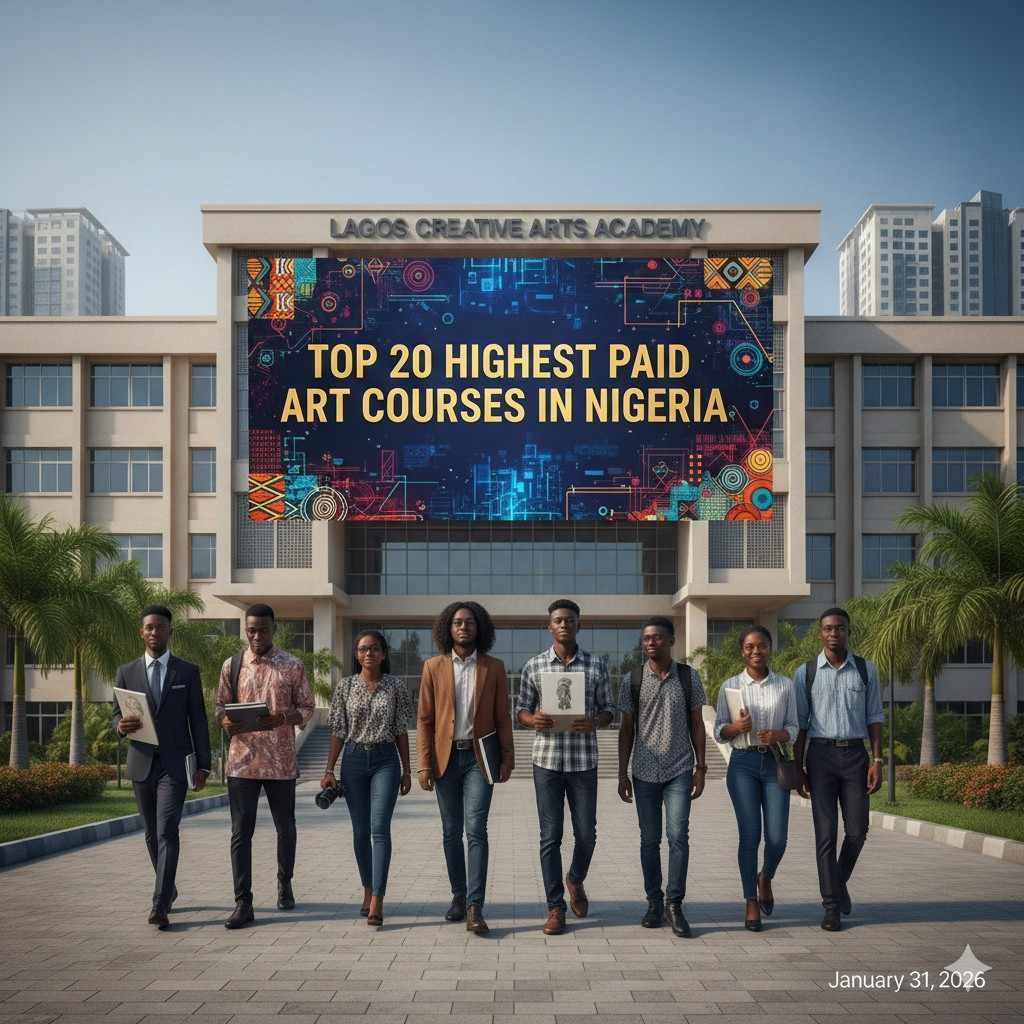
Top 20 Highest Paid Art Courses in Nigeria
1. Law (LL.B)
Average Starting Salary: ₦250,000 – ₦500,000/month (corporate firms)
Peak Earning Potential: ₦2M – ₦15M+/month (Senior Associates, SAN)
JAMB Cutoff: 240-280+ (depending on university)
School Fees Range: ₦150,000 – ₦850,000/year
Let’s be honest—Law still runs Nigeria. Whether it’s politics, business, entertainment, or tech, lawyers are eating. But here’s what they won’t tell you in those career talks: the first three years after Law School can be brutal. You’ll work ridiculous hours for pay that’ll make you question your life choices.
But if you survive that period and position yourself right, the law opens doors that nothing else can. I’m talking about partnership tracks in firms where annual bonuses exceed most people’s yearly salaries.
Or using your law degree to transition into corporate governance, compliance, or even tech (yes, tech companies are desperately hiring legal counsel for data protection and regulatory issues).
Best Universities: UI, Unilag, ABU, UNIBEN, OAU
Pro tip: Your law school result matters more than your university. BL matters more than your LL.B class. And your first firm matters most of all.
2. Mass Communication
Average Starting Salary: ₦180,000 – ₦400,000/month
Peak Earning Potential: ₦1M – ₦8M+/month (Media executives, Content strategists)
JAMB Cutoff: 200-250
School Fees Range: ₦120,000 – ₦600,000/year
Mass Comm has evolved beyond newspapers and TV stations. The real money now is in digital media, content strategy, and brand communications. I know graduates pulling ₦500k monthly as social media strategists for fintech companies—and they’re working remotely in pajamas.
The catch? Your school’s reputation matters less than your portfolio. I’ve seen Covenant University Mass Comm graduates struggle to find jobs while someone from a state university with a killer blog and 50k Twitter followers gets multiple offers.
Where the money is:
- Corporate communications (banks, telcos, oil & gas)
- Digital marketing agencies
- Content creation for international clients
- PR consultancy for politicians (election seasons are goldmines)
Best Universities: Covenant, UNILAG, Babcock, Pan-Atlantic
Reality check: Start building your personal brand from year one. Your follower count might matter more than your CGPA.
3. Economics
Average Starting Salary: ₦200,000 – ₦450,000/month
Peak Earning Potential: ₦1.5M – ₦10M+/month (Economists, Financial analysts)
JAMB Cutoff: 220-260
School Fees Range: ₦100,000 – ₦500,000/year
Economics is that beautiful hybrid course that arts students can use to break into finance without studying pure sciences. Banks, consulting firms, NGOs, international organizations—everyone needs economists.
But here’s the insider secret: don’t just study Economics. Add data analysis skills (Python, R, Excel modeling), get financial certifications (CFA, ACCA while still in school, and you’ll be earning more than many engineers.
I know an Economics graduate working as a data analyst for a UK company, earning $3,000 monthly. She’s 26. Another one works at the Central Bank pulling ₦800k before allowances—and that’s just four years after NYSC.
Best Universities: UI, Unilag, UNIBEN, OAU, UNILORIN
Pro tip: Your math skills will determine your ceiling. Weak math = limited opportunities.
4. Political Science/International Relations
Average Starting Salary: ₦180,000 – ₦400,000/month
Peak Earning Potential: ₦1M – ₦20M+/month (Diplomats, Political consultants)
JAMB Cutoff: 200-240
School Fees Range: ₦90,000 – ₦450,000/year
Don’t let anyone deceive you—Political Science can make you extremely wealthy, but not in the way your lecturers teach it. The real money is in political consulting, diplomacy, international development, and NGO leadership.
Election seasons turn sharp Political Science graduates into millionaires. I’m talking about ₦5M – ₦15M contracts for three months of campaign strategy work. But you need to build connections while in school.
Where the money is:
- Political consulting firms
- International development organizations (USAID, DFID, UN agencies pay in dollars)
- Diplomatic service (Nigeria Foreign Service pays well, but it’s competitive)
- Think tanks and policy research
- Corporate government relations roles
Best Universities: UI, Unilag, ABU, UNN, UNILORIN
Reality check: Your network is your net worth in this field. Join student political groups, volunteer for campaigns, and intern at NGOs.
5. English/Literary Studies
Average Starting Salary: ₦150,000 – ₦350,000/month
Peak Earning Potential: ₦800k – ₦5M+/month (Content strategists, Technical writers)
JAMB Cutoff: 180-220
School Fees Range: ₦80,000 – ₦400,000/year
Plot twist: English graduates are making serious money in tech. Technical writing, UX writing, content strategy, copywriting—these roles pay ₦400k – ₦1.2M monthly, and many are remote.
The traditional path (teaching, publishing) still exists but pays peanuts. The smart ones pivot into commercial writing. I know an English graduate who writes sales copy for U.S. real estate companies at $150 per page. She writes about 15 pages weekly. Do the math.
Modern career paths:
- Technical writing for SaaS companies (this pays ridiculously well)
- UX/Content design
- Copywriting for marketing agencies
- Grant writing for NGOs
- Publishing and editing for international platforms
Best Universities: UI, Unilag, UNIBEN, OAU, UNICAL
Pro tip: Learn SEO writing, technical documentation, and UX writing. These skills 10x your earning potential.
6. Accounting (under Social Sciences)
Average Starting Salary: ₦200,000 – ₦450,000/month
Peak Earning Potential: ₦1.5M – ₦8M+/month (Chartered Accountants, CFOs)
JAMB Cutoff: 220-260
School Fees Range: ₦120,000 – ₦550,000/year
Yes, Accounting is technically a social science course in many Nigerian universities, and it’s arguably the most reliable path to financial security among arts/commercial courses.
Every organization needs accountants. The profession is regulated, respected, and recession-proof. But here’s what separates the ₦150k accountants from the ₦1.5M ones: professional certifications.
The certification game:
- ICAN (mandatory in Nigeria)
- ACCA (international recognition)
- CPA (if you’re targeting U.S. companies)
Get these certifications early, and you’re practically guaranteed ₦500k+ monthly within five years of graduation.
Best Universities: Covenant, OAU, UI, Unilag, BUK
Reality check: The work can be monotonous. If you hate numbers and details, you’ll be miserable even with good pay.
7. Business Administration/Management
Average Starting Salary: ₦180,000 – ₦380,000/month
Peak Earning Potential: ₦1M – ₦10M+/month (Managers, Entrepreneurs)
JAMB Cutoff: 200-240
School Fees Range: ₦110,000 – ₦500,000/year
Business Admin is the ultimate generalist degree—both its strength and its weakness. You learn a bit of everything but master nothing. Your success depends entirely on what you do with the knowledge.
The winners in this field are those who specialize early: project management, business development, operations, supply chain. Or those who use it as a foundation for entrepreneurship.
High-paying niches:
- Project management (PMP certified managers earn ₦600k – ₦1.5M)
- Business development in tech/telecoms
- Operations management in logistics
- Procurement and supply chain management
Best Universities: Covenant, LASU, UI, Unilag, OAU
Pro tip: Get professional certifications (PMP, Six Sigma, PRINCE2). They matter more than your degree.
8. Insurance
Average Starting Salary: ₦180,000 – ₦350,000/month
Peak Earning Potential: ₦800k – ₦6M+/month (Underwriters, Brokers)
JAMB Cutoff: 180-220
School Fees Range: ₦90,000 – ₦400,000/year
Most people don’t even know this is a course. Those who do, underestimate it. Big mistake. Nigeria’s insurance industry is growing, and there’s a massive shortage of qualified professionals.
Insurance graduates with the right certifications (ACII, AINS) are commanding serious salaries, especially in specialized areas like oil & gas insurance, aviation insurance, or reinsurance.
Best Universities: UI, Unilag, Lagos State (LASU)
Reality check: You need to be comfortable with sales and client relationships. Introverts might struggle.
9. Theatre Arts/Performing Arts
Average Starting Salary: ₦120,000 – ₦300,000/month (early career)
Peak Earning Potential: ₦2M – ₦50M+/month (Established actors, producers)
JAMB Cutoff: 180-220
School Fees Range: ₦100,000 – ₦450,000/year
This one’s wildly inconsistent. You could be broke for five years, then suddenly become a multimillionaire. Nollywood is now a billion-dollar industry, and streaming platforms (Netflix, Prime Video, ShowMax) have changed the game completely.
But let’s be real: most Theatre Arts graduates struggle. The ones who make it combine talent with business sense. They’re not just actors—they’re producers, directors, content creators, voice-over artists.
Modern opportunities:
- Content creation for YouTube, TikTok (some creators earn ₦2M+ monthly)
- Voice-over work (especially for commercials and audiobooks)
- Film production
- TV presenting and hosting
- Brand influencing
Best Universities: UI, UNILAG, UniPort, UNICAL
Reality check: Talent alone won’t cut it. You need hustle, connections, and thick skin for rejection.
10. Linguistics
Average Starting Salary: ₦150,000 – ₦320,000/month
Peak Earning Potential: ₦700k – ₦4M+/month (Translators, Language consultants)
JAMB Cutoff: 180-210
School Fees Range: ₦80,000 – ₦380,000/year
Linguistics is the ultimate underdog course. Most people don’t understand what it is, yet linguistics graduates are quietly making money in translation, localization, computational linguistics, and speech therapy.
With Nigeria’s language diversity and the global need for translation services, smart linguistics graduates are earning in dollars. I know someone translating documents for international law firms at $50 per page. Another works in localization for a gaming company—₦600k monthly.
Best Universities: UI, UNILAG, ABU
Pro tip: Specialize in computational linguistics or translation studies. The future is in AI language models, and they need linguists.
11. History & International Studies
Average Starting Salary: ₦150,000 – ₦300,000/month
Peak Earning Potential: ₦800k – ₦5M+/month (Researchers, Curators, Consultants)
JAMB Cutoff: 180-220
School Fees Range: ₦85,000 – ₦400,000/year
History graduates who know how to package themselves are doing well in museums, cultural heritage management, research institutions, and even in the entertainment industry as consultants for historical films and documentaries.
Best Universities: UI, ABU, OAU, UNN
Reality check: You’ll probably need a master’s degree to maximize earnings.
12. Philosophy
Average Starting Salary: ₦140,000 – ₦280,000/month
Peak Earning Potential: ₦600k – ₦3M+/month (Ethics consultants, Writers)
JAMB Cutoff: 170-210
School Fees Range: ₦75,000 – ₦350,000/year
Philosophy teaches critical thinking—a skill desperately needed everywhere but rarely taught formally. The smart ones transition into consulting, ethics compliance (big in tech and finance now), or writing.
Best Universities: UI, UNN, UNILORIN
13. Sociology/Anthropology
Average Starting Salary: ₦150,000 – ₦300,000/month
Peak Earning Potential: ₦700k – ₦4M+/month (Researchers, Social strategists)
JAMB Cutoff: 180-220
School Fees Range: ₦80,000 – ₦400,000/year
Sociology graduates are finding opportunities in market research, social research for NGOs and international organizations, human resources, and community development.
Best Universities: UI, UNILAG, ABU, UNIBEN
14. Geography & Planning
Average Starting Salary: ₦180,000 – ₦350,000/month
Peak Earning Potential: ₦800k – ₦5M+/month (Urban planners, GIS specialists)
JAMB Cutoff: 190-230
School Fees Range: ₦90,000 – ₦420,000/year
With rapid urbanization, urban planners and GIS (Geographic Information Systems) specialists are in high demand. Government agencies, real estate companies, and environmental organizations are hiring.
Best Universities: OAU, UI, UNIBEN, ABU
Pro tip: Learn GIS software. It’s a game-changer.
15. French/Foreign Languages
Average Starting Salary: ₦160,000 – ₦340,000/month
Peak Earning Potential: ₦700k – ₦4M+/month (Translators, Interpreters)
JAMB Cutoff: 180-220
School Fees Range: ₦85,000 – ₦400,000/year
French graduates are making money in diplomatic services, international organizations, translation, and teaching. With Nigeria’s proximity to Francophone countries, opportunities abound.
Best Universities: UI, OAU, ABU, UNILORIN
16. Religious Studies/Islamic Studies
Average Starting Salary: ₦130,000 – ₦270,000/month
Peak Earning Potential: ₦600k – ₦3.5M+/month (Chaplains, Consultants)
JAMB Cutoff: 170-210
School Fees Range: ₦70,000 – ₦350,000/year
Beyond teaching and pastoral work, there are opportunities in chaplaincy (hospitals, military, prisons), religious consultancy, and interfaith dialogue programs.
Best Universities: UI, ABU, OAU, BUK
17. Music
Average Starting Salary: ₦100,000 – ₦250,000/month (inconsistent)
Peak Earning Potential: ₦1M – ₦100M+/month (Successful artists, producers)
JAMB Cutoff: 170-200
School Fees Range: ₦95,000 – ₦450,000/year
Nigeria’s music industry is global now. But success is extremely hit-or-miss. Most music graduates supplement their income with teaching, session work, or production.
Best Universities: UNILAG, UNIBEN, UNILORIN
18. Fine Arts/Visual Arts
Average Starting Salary: ₦120,000 – ₦280,000/month
Peak Earning Potential: ₦800k – ₦20M+/month (Established artists, Designers)
JAMB Cutoff: 170-210
School Fees Range: ₦90,000 – ₦420,000/year
Nigerian contemporary art is booming internationally. Plus, graphic design, animation, and digital art are lucrative. But you need business acumen alongside talent.
Best Universities: UNILAG, ABU, YABATECH, OAU
19. Criminology & Security Studies
Average Starting Salary: ₦170,000 – ₦330,000/month
Peak Earning Potential: ₦800k – ₦4.5M+/month (Security consultants)
JAMB Cutoff: 190-230
School Fees Range: ₦95,000 – ₦440,000/year
With Nigeria’s security challenges, experts in this field are increasingly valuable in corporate security, risk assessment, and security consultancy.
Best Universities: UI, UniAbuja, UNILORIN
20. Tourism & Hospitality Management
Average Starting Salary: ₦150,000 – ₦300,000/month
Peak Earning Potential: ₦700k – ₦4M+/month (Hotel managers, Tourism entrepreneurs)
JAMB Cutoff: 180-220
School Fees Range: ₦100,000 – ₦480,000/year
Nigeria’s tourism industry is underdeveloped but growing. Smart graduates are building tourism businesses or working their way up in international hotel chains.
Best Universities: UI, UNILAG, Covenant, Redeemer’s
The Uncomfortable Truth About “Highest Paid”
Here’s what I need you to understand: these salary ranges are not guarantees. There are possibilities. Two people can study the same course at the same university and have wildly different financial outcomes.
What makes the difference?
1. Certifications and Extra Skills
Your degree gets you in the door. Certifications get you promoted. Whether it’s ICAN for Accounting, digital marketing certifications for Mass Comm, or PMP for Business Admin—these matter.
2. Where You Work
₦250k at a bank in Lagos is not the same as ₦250k at an NGO in Calabar. Multinationals, tech companies, oil & gas, telecoms—these sectors pay more. Government jobs and NGOs (except international ones) generally pay less.
3. Your Network
I hate that this is true, but it is. Many of the highest-paying opportunities never get advertised. They go to someone who knows someone.
4. Hustle and Adaptability
The job market doesn’t care about your course alone. Can you solve problems? Can you learn new skills? Are you willing to pivot?
What About School Fees and Cutoff Marks?
The fees I’ve listed are estimates for federal and state universities. Private universities charge significantly more (₦500k – ₦2.5M per year), but often provide better facilities and industry connections.
Cutoff marks fluctuate yearly based on:
- Number of candidates
- The university’s admission quota
- Departmental capacity
- Post-UTME performance
Pro tips for admission:
- Always aim 20-30 points above the typical cutoff
- Your O-level results matter more than people admit
- Post-UTME can make or break your chances
- Some universities admit more based on the catchment area
My Final Advice (From Someone Who’s Seen Both Sides)
I’ve watched hundreds of students graduate. Some are thriving, others are struggling despite having “better” courses or grades. Here’s what I’ve learned:
Don’t choose a course solely based on earning potential. You’ll be miserable studying something you hate for four years, and you’ll be even more miserable working in that field for 40 years.
But also don’t choose solely based on passion. Passion doesn’t pay bills. Find the intersection between what you can tolerate doing, what you can be good at, and what the market needs.
Start building your career from year one. Don’t wait until the final year to think about jobs. Intern, volunteer, freelance, build a portfolio, network. Your degree is just a foundation.
Be willing to pivot. The course you study doesn’t have to define your career. Some of the wealthiest people I know work in fields completely unrelated to their degrees.
Develop meta-skills. Communication, critical thinking, digital literacy, and emotional intelligence—these matter more than your specific course knowledge.
And whatever you do, don’t let anyone pressure you into a course because it’s “prestigious” or because it worked for them. This is your life. Your career. Your future.
Choose wisely, but also remember: your course doesn’t determine your destiny. Your choices after admission matter far more.
What course are you considering? And what’s holding you back from making a decision?
SEE RELATED POST >> Top 20 Best Art Courses in Nigeria and their Cut Off Marks
Discover more from SteezeTech
Subscribe to get the latest posts sent to your email.

Wow, I’ve really learned a lot today, thanks to you all, Keep up the good work.
Thank you, and welcome!